




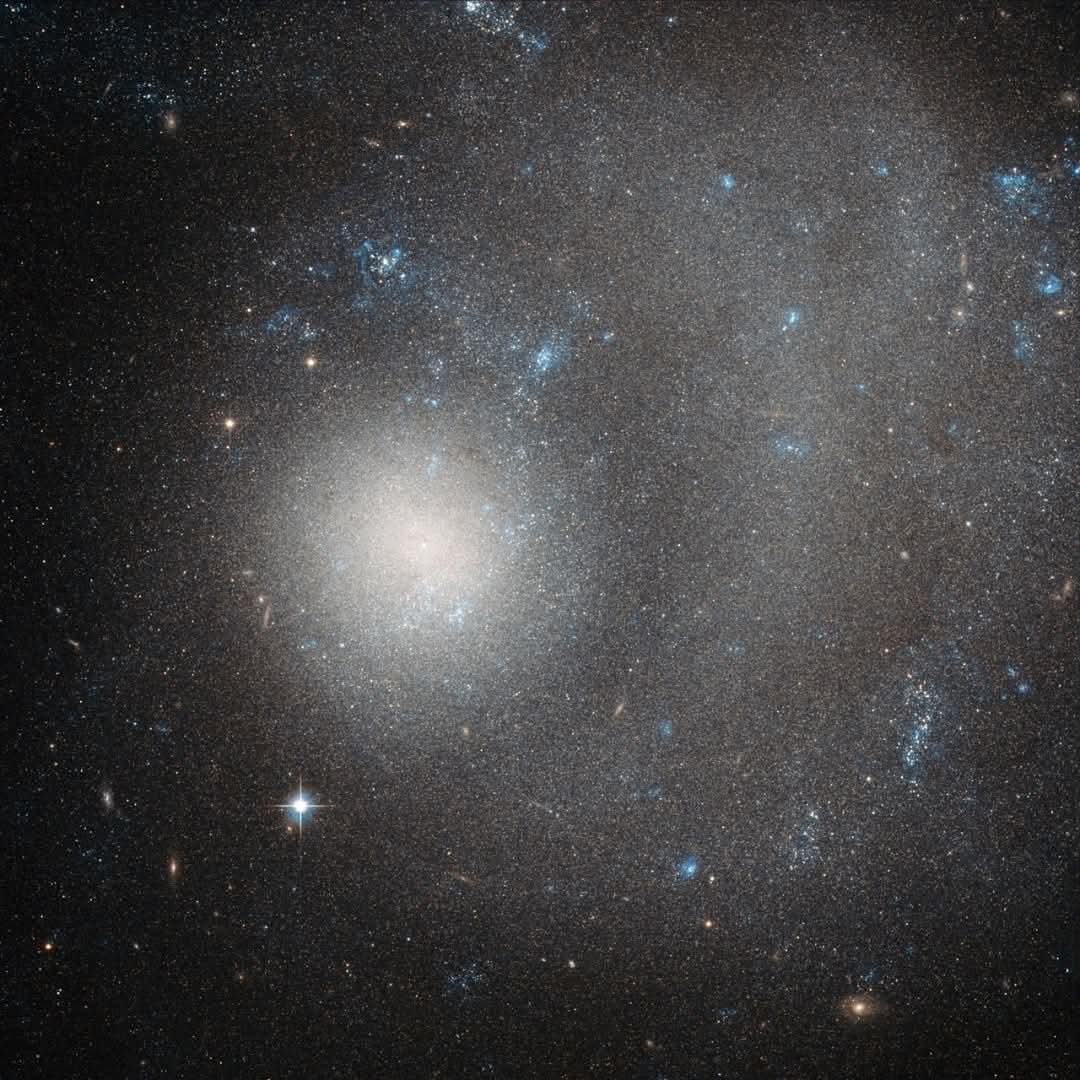
This image from the Hubble Space Telescope features the seemingly ordinary dwarf galaxy NGC 5474, located about 21 million light-years away in the constellation Ursa Major.
Despite its classification as a dwarf galaxy, NGC 5474 contains several billion stars. Still, compared to larger galaxies—some of which host hundreds of billions or even trillions of stars—it remains relatively small. What makes NGC 5474 especially intriguing are its unusual structural features. The galaxy’s disk is offset from its bright central nucleus, which is clearly visible in the image. Its star-forming regions are also displaced relative to the nucleus, and faint signs of spiral structure can be detected.
NGC 5474 is a member of the Messier 101 Group. Astronomers suspect that its distorted appearance may be the result of past gravitational interactions, likely with the group’s brightest member—the Pinwheel Galaxy (Messier 101). Such interactions are common among neighboring galaxies and can dramatically reshape their structures.
This sparkling image was released in 2014 and was created using optical and infrared observations taken with Hubble’s Advanced Camera for Surveys (ACS).